
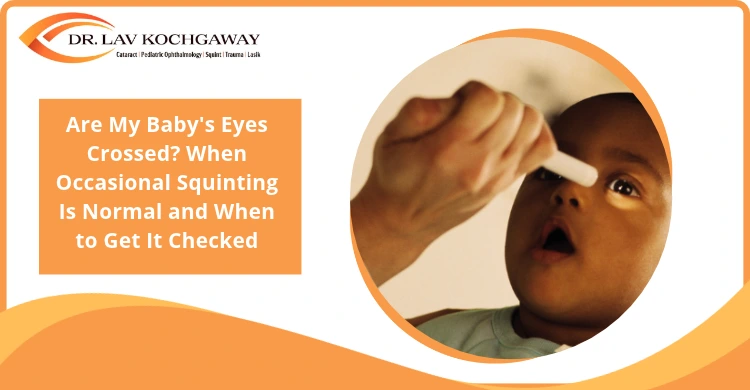
You catch your baby’s eyes drifting towards the nose while she looks at a toy, or one eye wandering outwards when she is sleepy. Grandparents notice it too, and the family splits into two camps: “It will settle by itself” and “Get it checked.” Both can be right, depending on the baby’s age and what exactly the eyes are doing.
Let’s understand what is normal in the first months, how a false squint differs from a true one, and the point after which drifting eyes should no longer be dismissed.
At birth, the visual system is still learning. The brain has not yet taught the two eyes to work as a team, so for the first few months occasional crossing or drifting is common, especially when the baby is tired or looking at something close. By around four months, most babies can hold their eyes steady and follow a moving object. This is why a brief, occasional wobble in a young infant is usually part of normal development, while crossing that appears regularly after four months is generally not.
Some babies only look cross-eyed. A broad, flat nose bridge and a fold of skin at the inner corner of the eye (an epicanthal fold) can hide the white of the eye on the side near the nose, so the eye seems to turn in. This is called pseudo squint. The eyes are actually straight, and it often fades as the face grows.
A true squint (strabismus) means the eyes are not aligned. The key distinction is that a false squint looks the same whichever way the baby looks and does not change with tiredness, while a true squint may be constant, may involve the same eye repeatedly, or may worsen when the baby is unwell or sleepy. Telling the two apart by sight alone is not always possible, even for experienced parents, because a baby can have a prominent nasal fold and a real squint together.
In a dimly lit room, hold a small torch or phone light about an arm’s length away and let your baby look at it. Observe where the small reflection of light falls on each pupil. If it sits at the same spot in both eyes, the eyes are probably aligned. If it falls in the centre of one pupil and towards the edge of the other, there may be a squint.
This is only a rough guide. It cannot detect small or intermittent squints, and a baby who will not look at the light cannot be assessed. A normal result at home therefore does not replace an eye examination. Photographs can also help: if one eye is repeatedly turned in your flash photographs, show the pictures to the doctor. A white or grey glow in one pupil in a photograph, rather than the usual red glow, needs prompt examination.
Take your baby for an eye examination if you notice:
When eyes point in different directions, the brain may start to ignore the signal from one of them. Over time, that eye can become a lazy eye (amblyopia) because the visual pathway does not develop properly. The earlier a squint is found, the better the chance of protecting vision, and it also gives the doctor time to look for causes such as a need for spectacles. Even a baby with a harmless pseudo squint may develop a true squint later, so a review at the right time is still worthwhile. Our blog on amblyopia explains how this develops and is treated.
A paediatric ophthalmologist checks how the eyes move and fix on a target, measures the alignment with cover tests, and examines the structures inside the eye. In most infants, a drop is used to relax the focusing muscle so that the spectacle power can be measured accurately. Treatment depends on the cause and may include spectacles, patching to strengthen the weaker eye, or in some children surgery on the eye muscles. Some of the options are described in this Netralayam article on non-surgical treatments for squint. Not every squint needs surgery, and the right plan is decided only after an examination.
It is also useful to know that a baby’s eyes are generally checked at around six months, even without any concerns. Our overview of common paediatric eye conditions lists other problems to watch for.
Note when the crossing happens (tired, unwell, looking close or far) and whether it is always the same eye. A short phone video taken in good light is often more useful to the doctor than a description. Avoid trying to “exercise” the eyes or cover one eye at home, since patching without guidance can interfere with development. Encourage normal play and eye contact, and keep any scheduled paediatric check-ups.
If you are unsure whether what you see is normal, it is reasonable to have it checked rather than wait. Book a consultation with Dr. Lav Kochgaway, a paediatric ophthalmologist in Kolkata, for a gentle examination of your baby’s eyes. His paediatric eye care service covers squint evaluation, spectacle checks and follow-up.
Yes. Some babies are born with a squint, and it can also appear in the first year. Constant crossing, even in a newborn, is a reason for an early eye examination.
A false squint often improves as the nose bridge develops, but a true squint usually does not resolve on its own. Waiting can allow a lazy eye to develop, so confirm with a doctor first.
There is no good evidence that sleeping position causes squint. Squint is linked to factors such as family history, prematurity and uncorrected spectacle power, though the cause is often unclear.