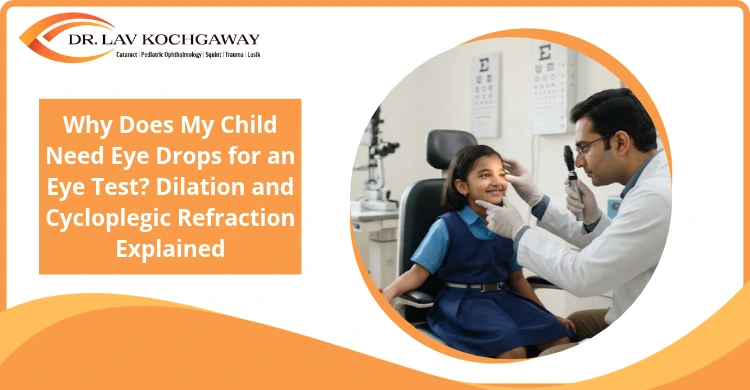
A parent books an eye test for their child, and the clinic says, “We will need to put drops in.” Many parents hesitate. Will it sting? Will the child be able to go to school? Is it really necessary, or can the test be done without it? Some quietly postpone the visit, and the problem, if there is one, goes on unnoticed.
Short answer: for children, drops are often the only reliable way to measure the true spectacle power. Let’s understand why the drops are used, what your child will feel, and how long the effects usually last.
Children have a much stronger focusing ability than adults, and this can temporarily mask their true spectacle power during an eye test. Their focusing muscle (the ciliary muscle) is strong and constantly active, and it can tighten on its own during the test, especially when they look at a chart or a close object.
This matters because the muscle can hide the true prescription. A child who is long-sighted can focus the extra power away and read the chart well, so a mild or even moderate degree of long-sightedness may be missed. In other children, the same effort can make short-sightedness look stronger than it is. Cycloplegic drops relax the focusing muscle for a short time, so the doctor measures the eye at rest. Without them, a child may be given spectacles that are too strong, too weak or not needed.
Parents often hear “dilating drops” as one idea, but two effects are involved:
Some drops produce mainly dilation, while others, such as cyclopentolate, do both. The choice depends on the child’s age, the colour of the eyes and what the doctor needs to check. In some children, such as those with a squint or significant long-sightedness, a stronger and longer-acting drop may be preferred. The measurement made under drops, called cycloplegic refraction, is often the most dependable reading of a child’s true spectacle power, though the doctor also considers the child’s symptoms and other findings before prescribing.
The drops usually sting for a few seconds, and some children cry more from surprise than pain. After about 30 to 45 minutes the pupils become large and the focusing muscle relaxes, so your child may notice:
These effects are temporary and usually wear off over several hours, and sometimes up to a day with the stronger drops. Atropine, used in a small number of children, can last a week or more, and the doctor will explain this beforehand. Rarely, a child may become flushed, drowsy, restless or dry-mouthed. Tell the doctor if your child has reacted to eye drops before or has any known medical condition.
Preparation makes the visit smoother:
Many parents also worry that the drops will harm the eyes. When used by an ophthalmologist, in the right strength for the child’s age, they are considered safe, and the effects are temporary. What should never happen is using leftover drops at home or letting a child skip the test.
After the history and a basic vision check, the drops are put in and the child waits, usually 30 to 45 minutes, for them to work. This waiting period is a good time for a snack and a quiet activity that does not need close focus, such as listening to a story. The doctor then measures the spectacle power with an instrument called a retinoscope, which does not need the child to answer questions, and examines the back of the eye. Because the retinoscope reading does not depend on the child’s replies, it suits toddlers and shy children who cannot yet read a chart.
Drops are most valuable if your child is squinting, has frequent headaches, holds books very close, sits close to the television, complains of tired eyes, or has a family history of strong spectacle power or squint. They also help in children whose spectacle power seems to keep changing, a pattern we describe in our blog on early signs of short-sightedness. Detecting a hidden power early can also prevent a lazy eye, a condition explained in our guide to amblyopia.
For a wider view of why regular testing matters, see our blog on the importance of a children’s eye test.
A few minutes of temporary discomfort can help the ophthalmologist get a much more accurate understanding of your child’s vision, so for most children the drops are worthwhile. If your child is due for a check-up or you have noticed any of these signs, book an examination with Dr. Lav Kochgaway in Kolkata. His pediatric eye care service is built around making the visit calm for both child and parent.
A basic screening may be possible, but it can miss hidden long-sightedness or overstate short-sightedness. If an accurate prescription is needed, the ophthalmologist may still recommend drops.
Many children return the same day, but near vision may stay blurred for several hours, so it is better to schedule the test when reading and writing can wait.
No. When prescribed and applied by an ophthalmologist, the effects are temporary, and the pupil and focusing return to normal.